

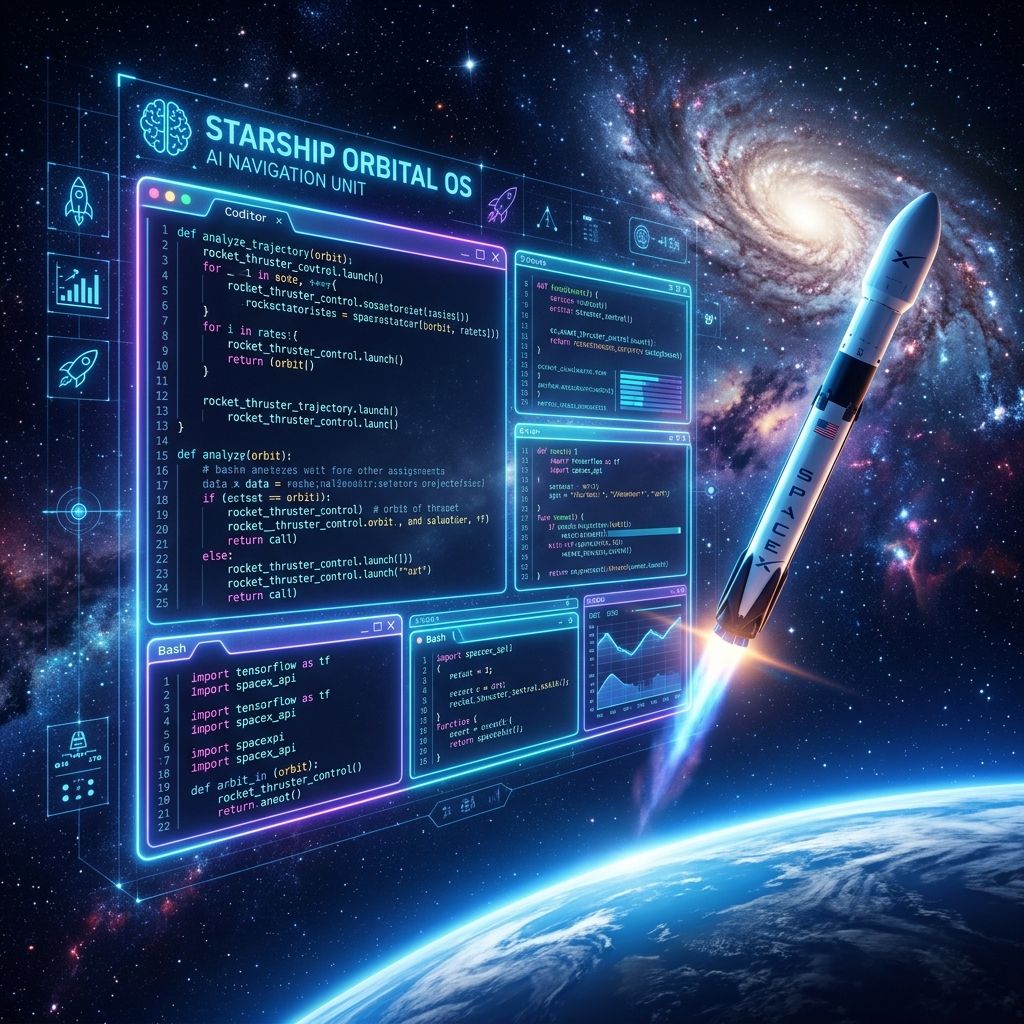
A Historic Tech Acquisition
In a groundbreaking move that bridges the gap between artificial intelligence and aerospace engineering, SpaceX has announced its acquisition of Cursor, the highly popular AI-powered code editor developed by Anysphere. The all-stock deal, valued at an astronomical $60 billion, marks one of the largest acquisitions in tech history.
By bringing the world's leading AI-native IDE under the SpaceX umbrella, Elon Musk is signalling a massive shift in how aerospace, satellite, and telecommunications software will be built in the next decade.
---
The Strategic Value of "Vibe Coding"
Cursor has revolutionized how developers write software, introducing the concept of "vibe coding" where developers act as system orchestrators rather than syntax writers. SpaceX intends to integrate Cursor into its broader ecosystem, particularly its xAI division and the Colossus supercomputer cluster. By owning the developer workflow, SpaceX aims to accelerate its software engineering pipeline, from rocket avionics to satellite network management.
Key Synergies
- Integration with xAI: Cursor will likely be powered by advanced, low-latency Grok models, challenging Microsoft's GitHub Copilot.
- Starlink Network Optimization: The acquisition will allow SpaceX to rapidly prototype and deploy complex routing algorithms.
- Next-Gen Avionics: Automating C++ code verification for Falcon and Starship telemetry.
---
Avionics and Real-Time Telemetry Automation
One of the most immediate applications of Cursor's AI inside SpaceX is the automation of avionics code generation. Space flight requires real-time, zero-garbage-collector execution, typically written in bare-metal C++ or Rust.
By feeding SpaceX's hardware-in-the-loop (HIL) testing data into Cursor's contextual retrieval systems, engineers can generate and verify safety-critical code in seconds.
Here is an example of the kind of low-level sensor polling code that SpaceX engineers are automating with Cursor's multi-file codebase indexing:
#include
#include
#include

class TelemetrySensor {
public:
    double getChamberPressure() {
        // Simulated sensor reading (in PSI)
        return 3200.0 + (rand() % 100 - 50) * 0.1;
    }
};

void runTelemetryLoop() {
    TelemetrySensor sensor;
    while (true) {
        double pressure = sensor.getChamberPressure();
        if (pressure > 3250.0) {
            std::cerr << "[CRITICAL] Combustion Chamber Overpressure: " << pressure << " PSI" << std::endl;
            // Execute automatic fuel valve throttling sequence
        }
        std::this_thread::sleep_for(std::chrono::milliseconds(10));
    }
}
---
Market Reaction and the Future of IDEs
The acquisition has sent shockwaves through the tech industry. Analysts suggest that Microsoft and Google will need to respond aggressively to prevent a monopoly on developer workflows.
> "Owning the developer workflow is critical for the next decade of AI development," noted an industry analyst. "Whoever controls the editor controls the data loop that trains the next generation of software engineering agents."
With the deal expected to close in Q3 2026, the developer ecosystem is bracing for a new era of AI-native software engineering.